
Click the pic to see this on Amazon (affiliate link)
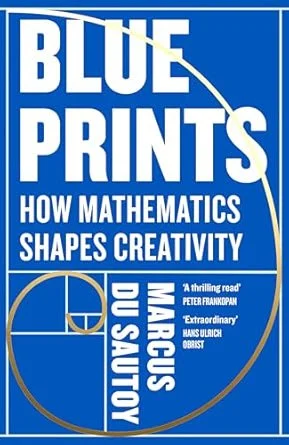
Reviewing a book not specifically intended for use in education is always a precarious enterprise. Doing so at a time when the National Curriculum is under scrutiny and likely to change is even more so. The interim review of the curriculum was published in March, and the final report was not due out until the autumn – and at the time of writing is yet to emerge. Nevertheless, we can feel fairly confident that Mathematics and English will continue to enjoy pride of place. Disappointingly, however, the notion of creativity is mentioned, almost in passing, only twice. Assuming that omission is not rectified in the final report, what place might Blueprints merit on a teacher’s bookshelves?
We might attempt an answer to that question by answering this one: what do the following people, amongst others, have in common? David Foster Wallace, Radiohead, Giotto, Le Corbusier. The answer is they, and many others engaged in what we might call the creative pursuits, all appear in this book, and they all use mathematics in their work, albeit sometimes unwittingly. Thus it is that Du Sautoy, in a single volume, has managed to effectively debunk C.P. Snow’s concept of the two cultures.
Indeed, a casual glance at the “Dramatis Personae” at the beginning of the book should dispel any lingering doubts. Writers, composers, architects and several other occupations make an appearance.
The interim curriculum review prioritises two things in particular for the purposes of this review. One is the continuing importance of English and mathematics in the curriculum, while the other is the aspiration for all young people to be able to see themselves represented in their learning. Let’s look at how Blueprints satisfies these requirements.
One of the strengths of the book is that it is interesting to read, with plenty of examples a maths teacher could draw on to bring the subject alive for those students who regard maths as a form of mysticism (or torture). Let’s put it this way: I “graduated” from secondary school knowing how to use logarithm tables and the definition of an Isosceles triangle. I’ve not used log tables since, and I wouldn’t know what do with an Isosceles triangle even if I tripped over one. In other words, if someone like me finds a book like this enjoyable and informative, there’s hope for everyone.
For example, in a discussion of the circle, rather than focus on “pi R squared” and so on, Du Sautoy examines Bach’s Goldberg Variations. Admittedly, that may also be rather esoteric in the context of a school, but it suggests to me that there is scope here for some cross-curricular collaboration between the maths and the music departments.
Du Sautoy draws together many other disparate strands. For instance, in the chapter on Symmetry, he discusses a work by a French writer, Raymond Queneau, called Exercises in Style. The idea, which I have used in my own creative writing courses and which could easily be adapted by the English department, is to take a very simple story and then rewrite it in several ways – Queneau tells the story ninety-nine times.
Again, in the chapter on prime numbers, the author draws upon Shakespeare’s use of the iambic pentameter, thereby also suggesting a potential collaboration between English and maths.
The second main hope for the curriculum, that all students should see themselves represented in their learning, is not met, or at least not in the way that the architect of the review, Becky Francis, probably had in mind. Yes, people from many different cultures are featured, but the cultures from which they come are not centre stage. On the other hand, given the wide range of contexts examined – art, architecture, stories and music to cite just a few – it would be almost inconceivable to not be able to find something of interest for everyone.
Where the book falls down is that, for me at least, the mathematical explanations are abstruse. But as a sourcebook of ideas for the maths teacher, and a very interesting read for the general reader who is rather more mathematically literate than I am, Blueprints could hardly be bettered.